





- 首页
- >
- 正文
Shanghai Sharks ready to bite their way back

After being eliminated in the first round of last year’s playoffs, Shanghai’s problems were laid bare: a lack of depth on the wings and a virtually nonexistent domestic point guard. Last summer, the front office addressed both weaknesses with targeted reinforcements. Now, as the season draws to a close, the results speak for themselves. The arrival of Zhang Zhenlin has reshaped the team’s two-way ceiling on the wing, while the sudden rise of Xie Li Yongwei has finally solved a long-standing issue at the point guard position.
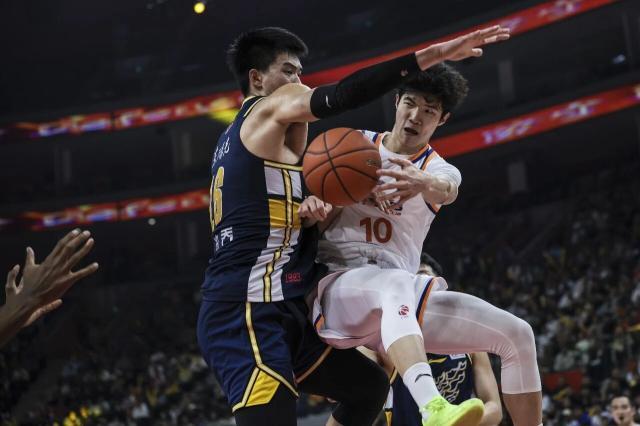
The Final Piece in Place
With upgrades on the wing and in the backcourt, Shanghai now boasts a domestic core with no glaring flaws. The foreign contingent is also deeper than last season—Lofton is no longer the lone solution, as Goodwin, Whiteside, and Fogg each bring distinct strengths. The numbers offer the clearest validation: first in offensive efficiency, first in defensive efficiency, and first in net rating per 100 possessions. The last team to achieve all three in a regular season was the 2018–19 Guangdong Southern Tigers, widely regarded as one of the greatest championship teams in CBA history.
The winning streak continues, the Club Cup is already secured, and the regular-season title is all but decided. The real test, however, lies in the playoffs. This team’s postseason experience and half-court offensive precision remain variables. Yet across the league, no team possesses overwhelming dominance—every contender has its own concerns. Shanghai may not be perfect, but at this moment, it is the closest to the finish line. A first title in 24 years? This time, they have genuine reason to believe.
Last season, Shanghai fell to Guangdong in the opening round of the playoffs. Beyond inexperience, structural flaws in the roster were evident: insufficient wing depth and the absence of a reliable domestic lead guard. Last summer, management addressed both issues with precision—and the results are now evident.
On the wing, Shanghai brought in national-team forward Zhang Zhenlin from Liaoning. The position now features veteran Liu Zheng, the fast-rising Li Hongquan, and Zhang anchoring the unit. A three-time CBA champion with Liaoning and a veteran of the FIBA World Cup, Zhang contributes on multiple levels, both on and off the court. Defensively, he and Liu can both take on primary assignments against opposing stars. As Liu ages, Zhang is expected to shoulder even greater defensive responsibility in the playoffs.
The other key upgrade lies at point guard. For a title contender, the single-import stretch in the fourth quarter is crucial. While Shanghai already has Wang Zhelin inside, the point guard position had long been a weakness. Yuan Tangwen offers limited shooting and is often left unguarded, while Cui Xiaolong—signed last summer—has been hampered by injuries, logging just 67 minutes this season. However, the rapid emergence of young guard Xie Li Yongwei has resolved a major concern for head coach Lu Wei.
Statistically, Xie has not made dramatic strides compared to last season, but his importance to the team has increased significantly. From the end of Phase One into the start of Phase Two, he became a catalyst for Shanghai’s winning streak. Lu Wei’s trust in him has grown steadily, often keeping the young guard on the floor in key moments. Xie has rewarded that trust—not through raw counting stats, but through a sharp rise in offensive efficiency. His three-point shooting has been particularly remarkable: he is converting 48.3% from deep this season, including an astonishing 68.4% from the corners. Regardless of which foreign player he partners with, he consistently generates excellent chemistry.
Speaking about Xie, Lu Wei said: “In the latter part of the first phase, he found his confidence and feel for the game. As a guard we are focusing on developing, he has performed very well during this stretch. Our coaches and trainers have been helping him, and he is very dedicated. He quickly absorbs feedback and corrects his bad habits.”
With improvements on the wing and at guard, Shanghai’s domestic roster now has few weaknesses. At the same time, the foreign players have combined more effectively than in previous seasons, fueling the team’s overall surge.
A Balanced Roster Comparable to 2019 Guangdong
There is no doubt that Lofton remains one of the best imports in the CBA. But relying solely on him would not be enough for Shanghai to go the distance. In last season’s playoffs, when opponents targeted his weaknesses and his emotions fluctuated, the team’s performance dropped sharply. This season, such a scenario is far less likely—because Shanghai is no longer overly dependent on him.
Early in the season, Lofton struggled with form and shot selection. Head coach Lu Wei even made him a DNP and held in-depth discussions with him. In hindsight, the “carrot-and-stick” approach proved effective. Although Lofton’s numbers are less explosive than last season, his on-court impact remains significant. Meanwhile, the strengthened import rotation makes it far harder for opponents to neutralize Shanghai by focusing solely on him.
Goodwin’s arrival has diversified the team’s perimeter offense. Unlike Harvey, who joined late in last season’s playoffs, Goodwin is a far more capable pick-and-roll initiator—running 8.7 pick-and-rolls per 36 minutes and generating 1.047 points per possession. He effectively connects the team’s highly efficient wing finishers, frequently setting up shooters like Li Hongquan and Li Tianrong.
Whiteside has been an unexpected bonus. Initially not a primary target, and underwhelming upon arrival, he has grown into an indispensable presence. His rim protection and rebounding have repeatedly helped Shanghai secure victories—especially in matchups against Guangdong, where he dominated the paint. When he is on the court, Shanghai’s offensive rebounding rate reaches 44.2%, and opponents shoot just 35.9% at the rim against him. Both metrics rank at the very top of the CBA.
Fogg may not shine as brightly as the others, but he plays the role of a veteran stabilizer, similar to Bledsoe last season. Crucially, as a former Finals MVP, his ability to adjust in high-stakes playoff situations should not be underestimated—he could well step up when the team needs him most.
With domestic weaknesses addressed and a stronger import rotation, Shanghai has emerged as the most dominant team in the league. The winning streak continues, and their net rating per 100 possessions leads the standings. Even more impressively, they rank first in both offensive and defensive efficiency. The last team to reach such heights in the regular season was the 2018–19 Guangdong squad, featuring Yi Jianlian, Marshon Brooks, Weems, Zhou Peng, and Zhao Rui—widely regarded as one of the greatest teams in CBA history.
Regular-Season Title Within Reach
With their winning momentum intact, multiple statistical categories topped, and the Club Cup already secured, Shanghai is unquestionably the hottest—and closest to a title—team in the CBA today. Even so, the team remains grounded.
“We have to stay clear-headed and fight for every game,” Lu Wei said in a recent interview.
Indeed, the playoffs present a far greater challenge than the regular season. Last year, Shanghai also surged late in the regular season, only to falter in the postseason. This season, while their regular-season performance has been outstanding, there are still areas for improvement. The domestic core lacks deep playoff experience, with most players yet to endure the intensity of semifinals or finals. Additionally, turnover control, foul drawing, and half-court execution all require refinement.
However, given the league’s current competitive landscape, no team holds absolute dominance. While Shanghai has its shortcomings, other contenders face even greater issues. Teams like Guangdong and Beijing have been inconsistent, while defending champion Guangsha continues to struggle with injuries.
All things considered, Shanghai is indeed the team closest to a championship. Not only are they in top form, but they are also highly likely to secure the regular-season title—granting them full home-court advantage in the playoffs, a crucial edge for a relatively young team.
At present, the gap between Shanghai and Guangsha in the standings remains narrow. However, Shanghai’s remaining schedule is more favorable, and they hold the tiebreaker advantage in head-to-head matchups. In other words, the regular-season title is effectively within their grasp. With home-court advantage throughout the playoffs, their championship push will carry even greater confidence.
It has been 24 years since Shanghai last lifted the trophy. Two full cycles have passed, and the glory of the past has long faded. A new generation of the Sharks is now swimming into the deepest waters of the playoffs. Whether they can bare their teeth at the finish line remains to be seen—but one thing is clear: this time, they are truly ready.
热门评论
全部评论
相关阅读
权威源自专业
“体坛+”是体坛传媒集团旗下《体坛周报》及诸多体育类杂志的唯一新媒体平台。 平台汇集权威的一手体育资讯以及国内外顶尖资深体育媒体人的深度观点, 是一款移动互联网时代体育垂直领域的精品阅读应用。