





- 首页
- >
- 正文
Better alternatives exist, skip ASEAN Cup now

Favorable luck smiled on China again. On May 9, the draw for the 2027 AFC Asian Cup was held in Riyadh, Saudi Arabia. As a Pot 3 team, China were grouped with Iran, Syria, and Kyrgyzstan. Having avoided Pot 2 World Cup sides Qatar, Iraq, and Jordan, this can be considered a slightly above-average draw.
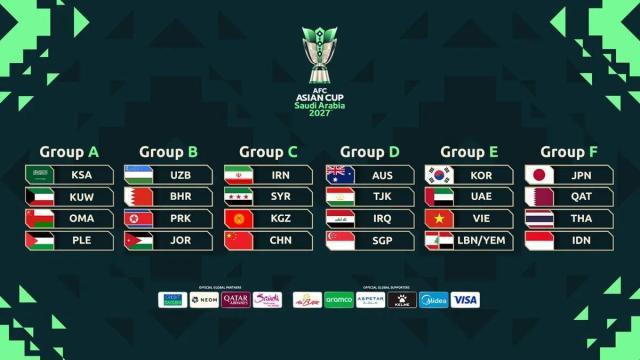
However, amid the optimism, a more sober reality emerges: China’s Asian Cup preparation likely needs a reset. Given the group opponents—and even potential Round-of-16 scenarios—China are unlikely to face Southeast Asian teams (unless finishing first and meeting the third team from Group F). Under such circumstances, participation in FIFA’s newly introduced ASEAN Cup warrants serious reconsideration.
Calendar Clash and Structural Dilemma
FIFA’s 2026 calendar reform merges the September and October international windows. For China, this creates complications. Head coach Shao Jiaqi took charge only in January, and since the end of the World Cup qualifiers last June, China have missed three international windows (six A-level matches), playing only in the EAFF E-1 Championship.
In contrast, Iran played seven friendlies including a Central Asian tournament. Syria participated in Asian Cup qualifiers, played four matches, held friendlies against UAE and Kuwait, and reached the quarterfinals of the FIFA Arab Cup. Kyrgyzstan’s schedule was closer to China’s, but they still joined a regional Central Asian competition.
The issue is compounded by squad overlap. With Shao promoting many U23 players, the September–October window will collide with the Asian Games. Key players such as Xu Bin, Yang Xi, Wang Yudong, and Baihelamu are expected to feature in the Asian Games, with potential overage reinforcements as well. The squad composition will differ significantly from the Asian Cup roster.
This raises a critical question: how much value do those windows hold? Yet, they remain essential for final preparation. By November, most teams will be fine-tuning their 23-man squads. If China are still working on tactical cohesion then, it will already be too late.
Realistically, China’s core preparation window should be the first half of 2026—especially the March and June windows. By June, the tactical framework and depth chart should largely be finalized. However, China’s June opponents—Singapore and Thailand—offer limited value. Their technical, possession-based style contrasts sharply with the physical profiles of Iran, Syria, and Kyrgyzstan, making them poor simulation targets.
Even with Asian Games conflicts, China must accelerate into a true Asian Cup preparation rhythm. Any further delay will only compress the timeline.
ASEAN Cup: Low Strategic Value
Despite this, China are pushing to participate in the FIFA ASEAN Cup in September. From a preparation standpoint, this is questionable.
Iran, Syria, and Kyrgyzstan rely heavily on physicality, while most Southeast Asian teams emphasize technique and quick interplay. Even Indonesia—with naturalized players—differs tactically. India, another invited team, has declined significantly and cannot replicate the level of China’s group opponents.
As for Thailand, Vietnam, Malaysia, and Singapore, China have faced them frequently in recent years at both senior and U23 levels, as well as in AFC competitions. Familiarity is high, and marginal learning value is minimal—especially given that China will already face Singapore and Thailand in June.
Better Alternatives Exist
If China skip the ASEAN Cup, better sparring partners are available.
With the merged windows, many regions already have commitments: the Gulf Cup in Saudi Arabia and UEFA Nations League fixtures limit options. However, several suitable teams remain:
Jordan (Asian Cup runner-up, not in the Gulf Cup)
Uzbekistan (coached by Fabio Cannavaro)
Australia (under Tony Popovic)
New Zealand
These teams offer stronger opposition and closer stylistic alignment with China’s Asian Cup group. Crucially, they are World Cup-level sides, ensuring higher-quality preparation.
Moreover, such friendlies would be mutually beneficial. Uzbekistan and Jordan both face North Korea in their groups, while Australia will meet Singapore—whose style resembles China’s.
Strategic Decision Point
With the draw finalized, the key question is clear: does participation in the ASEAN Cup still make sense?
This is a test of the Chinese FA’s strategic judgment. While Shao Jiaqi emphasizes a “Road to 2030” vision, and the ASEAN Cup may aid long-term development, the immediate priority remains the 2027 Asian Cup. A failure at the group stage would echo past disappointments under Zhu Guanghu, Gao Hongbo, and Aleksandar Janković.
热门评论
全部评论
相关阅读
权威源自专业
“体坛+”是体坛传媒集团旗下《体坛周报》及诸多体育类杂志的唯一新媒体平台。 平台汇集权威的一手体育资讯以及国内外顶尖资深体育媒体人的深度观点, 是一款移动互联网时代体育垂直领域的精品阅读应用。